

Juan, the White Slave & the Rebel Planter's Daughter by William D. Ritner (1857)
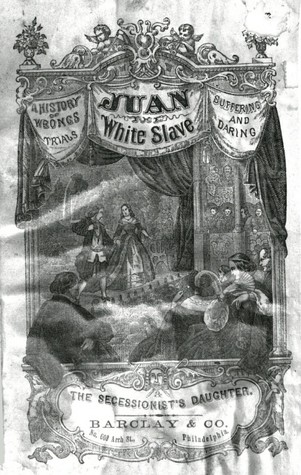
I feel like a literary archaeologist, reading these long-lost crappy little gems from the historical publishing underbelly. Outside of a trainwreck Harlequin or bodice ripper, I rarely have this much fun.
Juan, the White Slave; and the Rebel Planter's Daughter is an antebellum dime novel that is 57 different kinds of schizo plot WTF, crammed into 97 pages of very small type. 49 lines per page. (I counted.)
It's also a grammarian's nightmare. Tenses wobble between past and present, typos breed like bunnies, and you go from comma feast to famine on a regular basis. But I dare you to read it and not be charmed at least a little bit.
The story starts - and I say starts because the premise that is half-assedly set up gets chucked in favor of drama stings and arbitrary plot twists and scenes that are Utterly Freakin' Bizarre (but more on that later) - with the octoroon Juan being a star actor on the Philly stage. He's in love with the southern belle Beatrice Capello, but Beatrice is in love with Juan's friend Sinclair Duval. But Juan's co-star Cecelia is Sinclair's sweetheart and Beatrice decides to get rid of her rival. (Got all that?)
"Ooooh!" I thought. "This will be an intriguey kinda thing!"
Well, Beatrice apparently had a hair appointment and forgot all about her plans of vengeance, because we never hear about that again. (She gets her way, though, without getting her hands dirty, and the scene in which it happens is one of those rubbernecking WTFs that are scattered throughout this turgid little corker.)
It also turns out that Juan is related to more people in his life than he thinks. Every time a "I'm your _______!" happened, the world got smaller and smaller.
Juan is driven to avenge his dead slave mother by seeking out his father and killing him. (Guess who Beatrice's daddy is...)
The craziest part of the loosely-connected-series-of-events (it doesn't deserve the word "plot") are the group of young bloods and dandies who are chummy with the bad guy Livingston. As a sample of their scenes, and the writing, I give you the following:

This group of yahoos is part of a Jesuit conspiracy within the Secesh movement. Yes, Jesuits. The author makes no bones about being an anti-papist nativist, and has Livingston get his jollies by masquerading as a Jesuit priest with an elevator/trap door contraption in the confessional to lower unsuspecting female penitents into the dungeon below where he has his wicked way with them. (I shit you not.)
OK, this whole scene made me LOL my ass off, so you get to see it, too. Tim Pillington and Muzzy Mortimore (Best. Name. EVAR!) provide the lulz in spades:

Tim later dies of mortification when the leg of his doeskin trousers get snagged on a coach door and tears. There's no ambiguity about the scene at all. He dies of embarrassment. Zounds! (Seriously, y'all have got to read this and it's on Google Books, so there's no excuse not to.)
Juan gets stashed away in a silver mine in Peru (read it for yourself to find out how!) while the crazy stuff continues back in the States. He escapes (even if you read it, you won't find out how - he just does!) and things end all happy happy for the good guys. (But too bad about Cecelia.)
The last chapter is a rousing anti-slavery diatribe from the author. Weirdly, his attitudes about abolitionists is a bit ambiguous and inconsistent, but that doesn't seem to be Ritner's forte, at least not in the spelling department. (Honorable mention: "shackles" were "shuckles" at one point.)
So with The Three Stooges (give or take a few) yukking things up in duels and fashions and the overall utter lack of commas (I guess they were used to shell Vicksburg or something) and the absolutely ADD plot (which includes George Washington descending from heaven and zapping the asses of two slave-owners with lightning, all the while quoting Old TestamentIshityounot), Ritner's little tale enchanted me in spite of myself.
Originally published in 1857, it was reprinted in 1861 and then again in 1865 (probably in the flush of Union victory). This indicates some level of popularity among the masses.
"Hey, war is hell. Sometimes you just gotta read fun crap to get through the day-to-day."
-- William T. Sherman





0 Comments